
Professor Alejandro Ribeiro
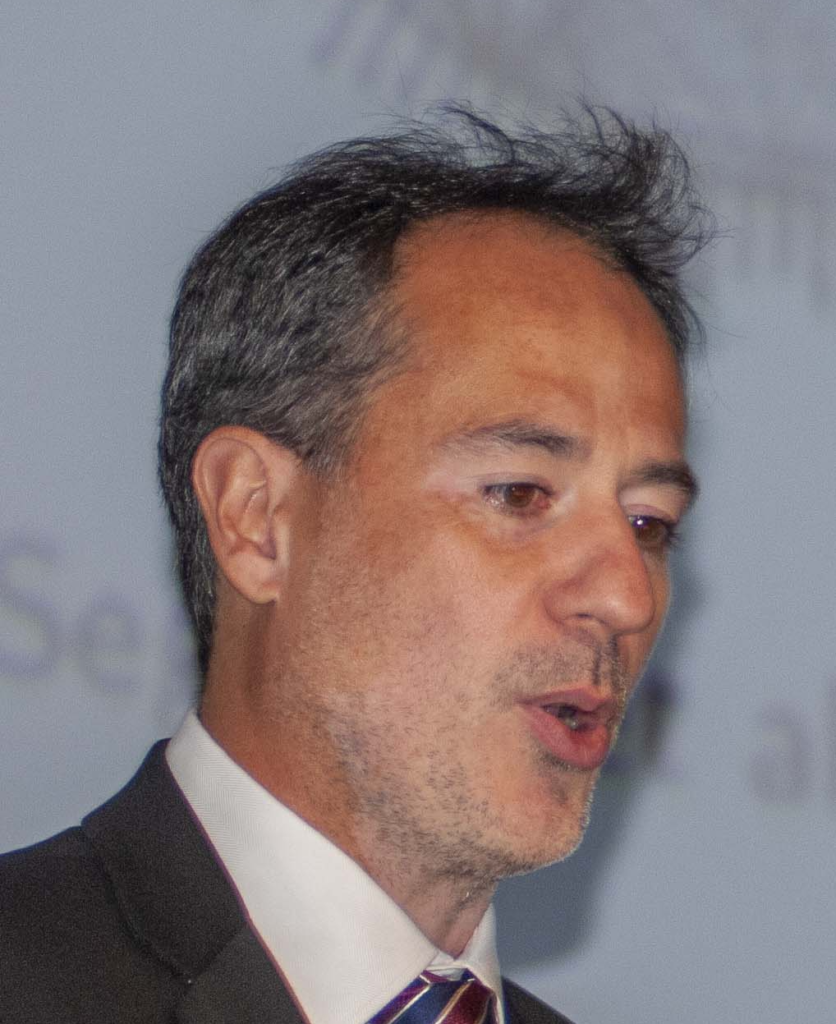
Welcome to the Graph Neural Networks (GNNs) course at Penn. My name is Alejandro Ribeiro (aribeiro@seas.upenn.edu) and I am very much looking forward to working with you. This course grew out of my research on GNNs and it is therefore very close to my personal interests. I believe that GNNs are a transformational technology that can have a high impact on the management of physical systems such as wireless communication networks, collaborative multiagent robotics and power distribution networks. GNNs will also impact a number of virtual world technologies such as recommendation systems. However, I am not a big fan of the virtual world and I don’t really care much about improving a recommendation system. I’d much rather we have better multiagent systems and power networks.
My research group is well known for its contributions to the fundamental understanding of AI information processing architectures. We try to determine what are the operations that we should perform on data to generate intelligent behavior and why do these operations should be expected to work or not. We are also active in developing theory and algorithms for learning with requirements. This has to do with developing AI systems that are good according to several metrics. They make, say, decisions that are within a specified range of optimal but are also fair and safe. Our application domains are multiagent autonomous systems, wireless communication networks, and network neuroscience.
I strive to be a good teacher and sometimes succeed. I am very proud to be the recipient of the 2012 S. Reid Warren, Jr. Award presented by the students of the School of Engineering and Applied Science for distinguished teaching and the 2017 Lindback award presented by my Penn colleagues for the same reason.
I also strive to be a good scientist and in this endeavor I am very much helped by the remarkable work of my doctoral students and postdocs. Their papers have received a number of awards which I am happy to claim as my own. These awards are the 2024 and 2022 IEEE Signal Processing Society Best Paper Award, the 2022 IEEE Brain Initiative Student Paper Award, the 2021 Cambridge Ring Publication of the Year Award, the 2020 Signal Processing Society young author pest paper award, the 2014 O. Hugo Schuck best paper award and paper awards at the 2023 Workshop on Computational Advances in Multi-Sensor Adaptive Processing, the 2021 European Signal Processing Conference, the 2020 International Conference on Acoustics, Speech and Signal Processing, the 2019 European Signal Processing Conference, the 2017 Conference on Decision and Control, the 2016 Workshop on Statistical Signal Processing, the 2016 Sensor Array, and Multichannel Signal Processing Workshop, the 2015 Asilomar Conference on Signals Systems and computers, the 2013 American Control Conference, and the 2005 and 2006 International Conferences on Acoustics, Speech, and Signal Processing. I have also been selected as a Fulbright Scholar class of 2003, a Penn Fellow class of 2015, and an Outstanding Researcher by Intel in 2019.
I am husband to Gabriela and father to Miranda (Penn Class of 2020), Guillermo(Penn Class of 2023), and Ariel (Penn Class of 2031, I hope).
If you think that I can ever be of assistance to you in the future, connect with my LinkedIn account.
Teaching Assistants

Javier Porras-Valenzuela (jporras@seas.upenn.edu) is a fourth year PhD. student advised by Prof. Alejandro Ribeiro. His research interests include graph neural networks, transformers, reinforcement learning and stochastic optimization. Originally from Heredia, Costa Rica, he holds a BSc. in Software Engineering from Universidad Nacional de Costa Rica (2015) and an MSc. in Computer Science from Tecnológico de Costa Rica (2022). He enjoys chess, hikes, and taking pictures in front of brick walls.

Beiming Li (beimingl@seas.upenn.edu) is a second-year PhD student advised by Prof. Alejandro Ribeiro and Prof. Vijay Kumar. His research interests lie in developing reinforcement learning techniques that solve multi-agent cooperation and competition at scale. He obtained his B.S. in Computer Engineering from the University of Michigan. He enjoys cooking, sports, and taking pictures on top of cars.

Ignacio Boero (iboero@seas.upenn.edu) is a third-year PhD student advised by Prof. Alejandro Ribeiro. His research interests lie in developing optimization theory and techinques for training and deploying machine learning systems. He completed his undergraduate studies in Electrical Engineering at Universidad de la República in Uruguay, where he was also involved in teaching and research. Outside of research, he enjoys all kinds of sports, exploring nature, and reading by the Schuylkill River.

Divyansha Lachi (div11@upenn.edu) is a fourth-year PhD student advised by Prof. Eva Dyer. Her research interests include Graph transformer, Graph foundation models, Relational Deep learning and Multi-Modal foundation models for time series data. Originally from India, she holds a BTech in Computer Science and Engineering from National Institute of Technology, Silchar. In her free time she enjoys cooking, playing tennis and speed cubing.

Teresa Shang (tshang@engineering.upenn.edu) is a fourth-year undergraduate studying AI and Robotics. Her research interests include representation learning, generative models, and graph transformers. She enjoys dancing, playing music, and walking around in Philly.

Aadam Mulla (amulla@engineering.upenn.edu) is a third-year undergraduate studying electrical engineering and data science. His academic interests lie in machine learning, signal processing, and information theory. He enjoys playing badminton, playing the guitar, and taking pictures while petting cats.